Kushinagar District
Kushinagar, Kusinagar or Kusinara is a town and a Nagar Panchayat in the Kushinagar district of the Indian state of Uttar Pradesh located around NH-28, and is 52 km east of Gorakhpur city. It is an important Buddhist pilgrimage site, where Buddhists believe Gautama Buddha attained Parinirvana after his death. Outside India, it is an International Buddhist Pilgrimage Centre. The followers of Buddhism, especially from Asian Countries, wish to visit this place at least once in their lifetime.
History
The present Kushinagar is identified with Kushawati( in pre-Buddha period ) and Kushinara (in Buddha period). Kushinara was the capital of Mallas which was one of the sixteen mahajanpads of the 6th Century B.C. Since then, it remained an integral part of the erstwhile empires of Maurya, Shunga, Kushana, Gupta and Harsha dynasties.
In medieval period, Kushinagar had passed under the suzerainty of Kultury Kings. Kushinara continued to be a living city till the 12th Century A.D. and was thereafter lost into oblivion. Padrauna is believed to be ruled over by a Rajput adventurer, Madan Singh in the 15th century A.D.
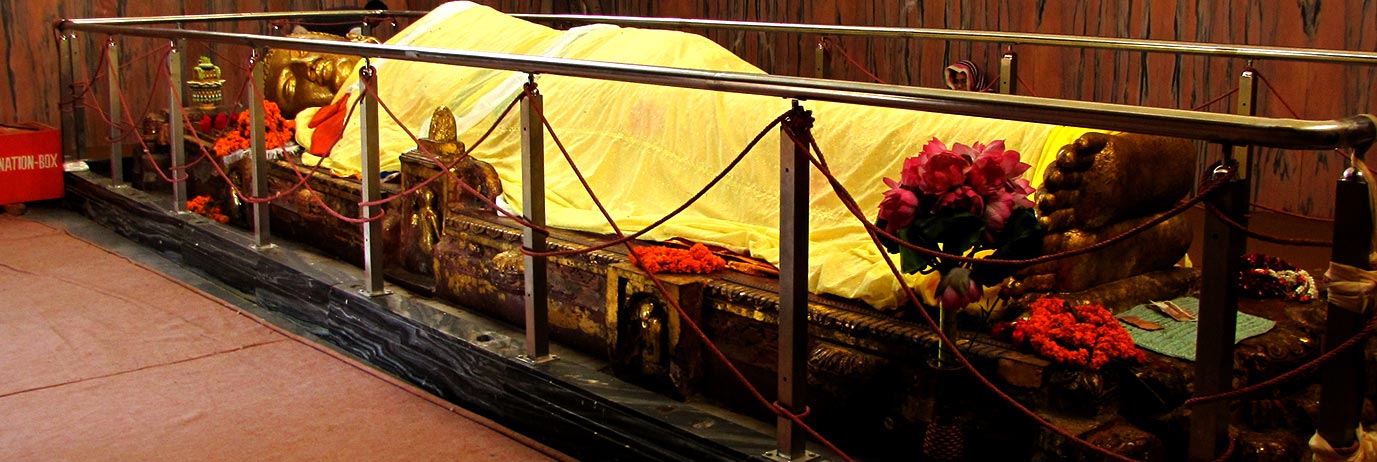
However, modern Kushinagar came into prominence in the 19th Century with archeological excavations carried out by Alexander Cunningham, the first Archeological Surveyor of India and later followed by C.L. Carlleyle who exposed the main stupa and also discovered a 6.10 meters long statue of reclining Buddha, in 1876 A.D. Chandra Swami, a Burmeses Monk, came to India in 1903 and made "Mahaparinirvana Temple" into a living shrine.
Parinirvana Stupa
One of the important Stupas in Kushinagar is the Parinirvana Stupa, Kushinagar. Indianholiday.com offers online information on Parinirvana Stupa, Kushinagar and other tourist attractions of Uttar Pradesh and other parts of India. Kushinagar is one of the destinations for a pilgrimage tour in purvanchal.

Wattthai Temple
Typical Thai Buddhist huge temple in architectural style.

Mathakuar Shrine
This shrine is about 400 yards from the Nirvana Stupa. A stone image of Lord Buddha in the 'Bhumi Sparsha Mudra' (earth touching posture) under the 'Bodhi tree' was excavated here. The inscription at the base of the statue dates it to 10th-11th century...

Ramabhar Stupa
About 1.5 km away from Mahaparinirvana Temple, this large Stupa rises to a height of 15 meters. It marks the site where the Lord Buddha was cremated. In ancient Buddhist texts, this Stupa has been referred to as 'Mukut-Bandhan Chaitya'.

Chinese Temple
Here the special attraction is a beautiful statue of Lord Buddha

Japanese Temple
A beautiful Ashta Dhatu (eight metal) statue of Lord Buddha which was brought from Japan